
Refund Madness
By: Main Street Alliance

Cold Open
I feel like for the last few weeks we’ve been providing hot-takes on why the war in Iran is a bad deal for Main Street. Admittedly, it felt a little tone deaf to me.
You know who the war in Iran is bad for? Iranians! All the families who wake up every morning in a hellscape. That, frankly, matters more than high gas prices for Americans. That what I just said would be a click-bait-y, controversial snippet on most media sites is kind of the problem.
I was happy to talk to Business Insider this week about what runaway crude prices have meant for entrepreneurs…but it’s not clear to me that that’s the story that needs to be foregrounded right now.
The danger of the Trump administration isn’t simply what his policies do. The danger is the flattening of current events…where high oil prices are made to seem like a disaster equal to schools being bombed. Those two things aren’t equal. They never will be.
We have a main street focus here at the Write Off, but I don’t want that focus to unnecessarily draw energy and attention away from the issues that, every day, are rotting our moral core.
Trust me, you don’t need our foreign policy opinions. But we’re bursting through the fourth wall a bit here to just do a temperature check for a second.
Hoping you all are managing to keep your heads on straight.
-Richard
The Big One: Congrats, You Can Apply to Get Your Own Money Back
TL;DR
The government is launching a portal for small businesses to reclaim billions in illegal tariffs. Sounds great, until you realize you have to apply, wait months, and maybe not even get all your money back. The system broke the economy, and now it’s asking small businesses to fix the paperwork.
The Gist
The government owes businesses up to $175 billion
After the Supreme Court ruled Trump’s tariffs illegal, the bill is coming due.They’re launching a “refund portal” on April 20
Businesses can apply through a system called CAPE to try to get their money back.Refunds are not automatic. At all.
You have to opt in, file correctly, and hope your claim gets processed.Only some tariffs qualify
Roughly 63% of claims may be eligible. The rest could take years or never come.Processing could take months, assuming no errors
And if your paperwork is off, welcome to bureaucratic purgatory.Wall Street already found the angle
Hedge funds are offering to buy small business claims at a discount so they can cashout faster.
Our Take
This is one of those stories that perfectly explains why people think the system is rigged. Small businesses paid billions in tariffs that were ruled illegal. Not misguided. Illegal. So naturally, the government’s response is not “we’ll send you your money back.” It’s: log into this portal, submit your claim, and we’ll get to it when we get to it.
Meanwhile, some businesses won’t qualify. Others will wait months. And a whole ecosystem of financial middlemen is already stepping in to skim value off the delay. That’s the real story.
When the system breaks in favor of large institutions, it moves fast. When it’s time to make small businesses whole, suddenly it’s paperwork and uncertainty. Costs go up immediately. Relief comes slowly, if at all. And someone in the middle profits off the gap.
If you’re wondering why trust in institutions keeps slipping, this is your answer.
WTF in the News
Even NFIB is admitting Main Street is struggling
Small business optimism just fell below its 52-year average
Uncertainty is spiking as owners hesitate to hire or invest
Costs are piling up: labor, inflation, and now rising oil
And NFIB’s response? Still pushing the same tax cut script, like nothing else is happening
Virginia is (still) moving on paid leave…with some changes
Governor Spanberger is advancing a paid family and medical leave program covering up to 12 weeks
Broad coverage, modest cost, years in the making after repeated setbacks
Quiet reminder that policies supporting workers also stabilize small businesses
Metric of the Week
71%
That’s the share of small businesses reporting higher healthcare costs in the past year
Also the same share saying they’ve been negatively impacted by tariffs
And part of a broader trend where 64% say expenses are rising while 47% say revenue is falling
Translation: costs up, revenue down, and policymakers still acting like this is a vibes issue instead of an economic one.
Ones to Watch
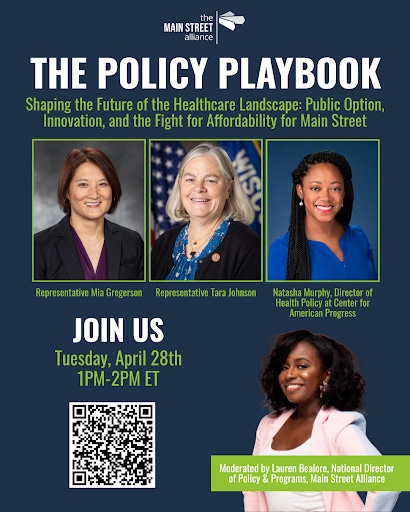
As healthcare costs continue to rise, states across the country are exploring new strategies to expand coverage and improve affordability. While only three states, that being Washington, Colorado, and Nevada, have implemented public option programs to date, momentum is building as more states introduce and debate similar legislation. This evolving landscape presents a critical opportunity to examine what works, what doesn’t, and how policymakers can tailor solutions to their unique state contexts.
Join us for another edition of The Policy Playbook series, featuring Representative Mia Gregerson (33, WA), Representative Tara Johnson (96, WI), and Natasha Murphy, Director of Health Policy at Center for American Progress.
Be sure to register today!
Sign-Off
We’re trying to double the reach of The Write Off by this summer.
If this resonated, send it to one person who should be paying attention to what’s actually happening on Main Street.
Appreciate you being here.
— Richard